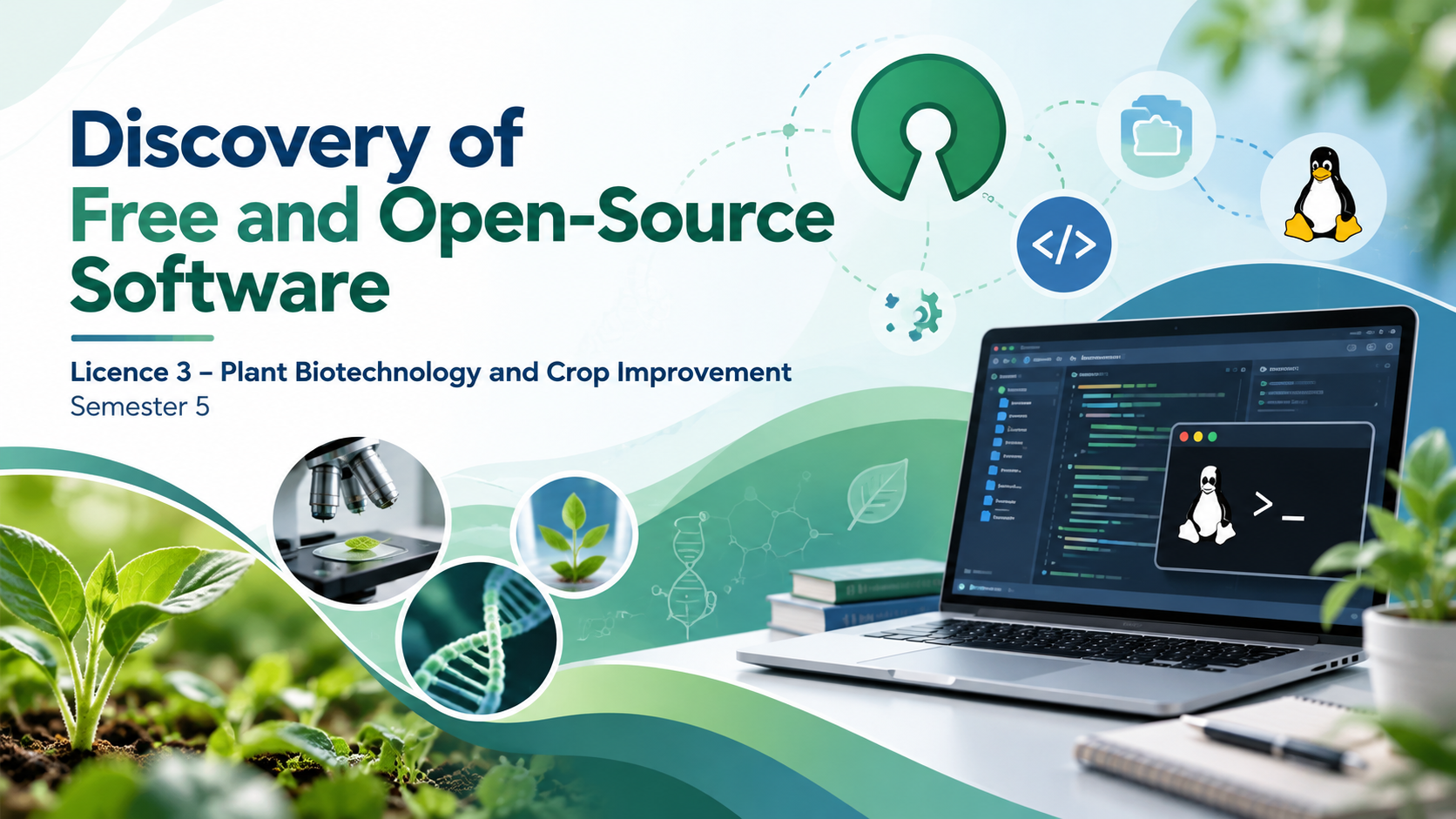
Discovery of Free and Open-Source Software
University: University of Echahid Hamma Lakhdar – El Oued
Faculty: Faculty of Natural and Life Sciences
Programme: Bachelor’s Degree (Licence 3) in Plant Biotechnology and Crop Improvement
Semester: 5
Teaching Unit: Discovery Unit (UED)
Total Teaching Hours: 45 hours
Weekly Workload: 1.5 hours of lectures and 1.5 hours of practical activities
Coefficient: 2
Credits: 2
Course Description
This course introduces students to the fundamental principles, concepts, and applications of free and open-source software, with particular emphasis on its use in biological sciences, plant biotechnology, and scientific research.
Students will explore the philosophy of open-source software, discover Linux operating systems, and develop essential skills in scientific document preparation, data management, bibliographic referencing, and collaborative research using freely available digital tools.
The course combines theoretical knowledge with interactive learning materials, video tutorials, practical exercises, and continuous assessment activities delivered through the Moodle learning platform.
Learning Objectives
Upon successful completion of this course, students will be able to:
-
Understand the fundamental principles of free and open-source software.
-
Distinguish between free, open-source, and proprietary software.
-
Identify and compare common open-source software licences.
-
Understand Linux operating systems and execute basic terminal commands.
-
Use open-source office applications to prepare scientific documents, spreadsheets, and presentations.
-
Manage scientific references using tools such as Zotero and JabRef.
-
Understand the fundamentals of version control using Git and collaborative platforms.
-
Apply open-source tools to organise, analyse, document, and share scientific data.
Course Content
Chapter I: Introduction to Free and Open-Source Software
Definitions, historical development, software freedoms, licensing, and examples of widely used open-source applications.
Chapter II: Free Operating Systems – Linux
Introduction to Linux distributions, installation, file management, terminal commands, permissions, and basic Bash scripting.
Chapter III: Office Applications and Scientific Project Management
LibreOffice, bibliographic reference management, version control using Git, collaborative platforms, and scientific data management.
Practical Learning Activities
Practical learning activities include Linux demonstrations, scientific document preparation, spreadsheet applications, reference management, and a mini-project involving the organisation and analysis of biological data.
Teaching and Learning Methods
The course is delivered through Moodle using:
-
Interactive lessons developed with SCENARI Opale.
-
Downloadable and illustrated PDF lecture materials.
-
Educational videos and software demonstrations.
-
Interactive exercises and self-assessment quizzes.
-
Practical assignments and scientific mini-projects.
-
Discussion forums and supplementary learning resources.
Assessment Methods
Student learning will be monitored through formative evaluations approximately every two weeks.
The official assessment consists of:
-
Final examination: 60%.
-
Continuous assessment: 40%.
The final examination and the required supervised continuous-assessment components will be conducted in person in accordance with the approved syllabus.
Recommended Background
No specific prior knowledge is required. Basic computer literacy is recommended.